Air fryers have become a familiar tool in many kitchens, but getting comfortable with cooking times and temperatures can take some trial and error. Unlike a conventional oven, an air fryer circulates hot air around food in a relatively compact cooking chamber, which means cooking results can vary depending on the appliance, food quantity, thickness, starting temperature, and desired level of doneness.
For someone learning how to use an air fryer, having a quick reference nearby can make everyday cooking more organized. This is where an air fryer cheat sheet can be useful. Instead of opening a phone, searching online, or checking several recipes just to find a starting temperature, a dedicated reference guide can provide commonly used information in a format designed to stay close to the cooking area.
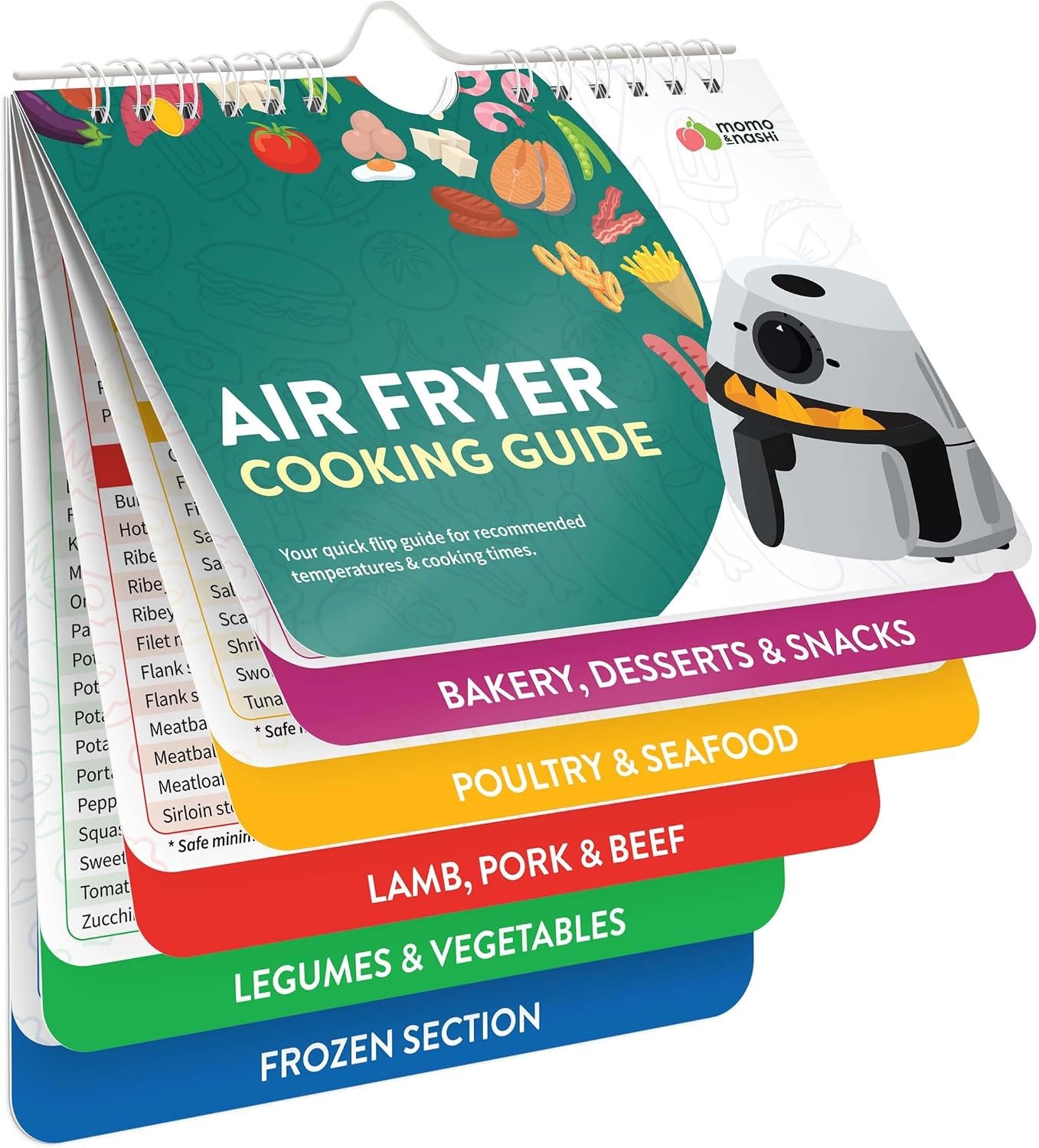
The Air Fryer Cheat Sheet Magnets Booklet from Momo & Nashi is designed around this idea. The product is presented as a magnetic cooking reference containing information for more than 120 foods, organized into categories such as meats, vegetables, snacks, legumes, and frozen foods. It also includes temperature references in both Celsius and Fahrenheit, along with additional cooking guidance.
The product is listed as a plastic-sheet and magnet item, with rectangular dimensions of approximately 7.36 by 6.46 inches.
This article explores what an air fryer cheat sheet booklet can offer, how this particular type of kitchen reference may fit into different cooking routines, and what shoppers should consider before choosing one.
What Is an Air Fryer Cheat Sheet?
An air fryer cheat sheet is essentially a compact reference guide for air-frying food.
Instead of functioning like a traditional cookbook with lengthy recipes and detailed preparation instructions, a cheat sheet focuses on information that is frequently needed during cooking. Depending on the guide, this can include suggested temperatures, approximate cooking times, food categories, preparation notes, and temperature conversions.
The concept is particularly useful for foods that people prepare repeatedly.
For example, someone may already know how to season chicken wings or prepare frozen vegetables but may not remember the approximate cooking temperature every time. A reference sheet positioned near the air fryer can provide a starting point without requiring a separate search.
It is important to understand that these references should generally be treated as starting points rather than universal cooking rules. Air fryer models differ in wattage, basket design, airflow, capacity, and temperature behavior. Food also varies in size and moisture content.
Consequently, cooking instructions should be adjusted when necessary, and food should be checked for proper doneness and food safety.
Overview of the Air Fryer Cheat Sheet Magnets Booklet
The Momo & Nashi guide is designed as a compact magnetic reference for air-fryer cooking.
According to the product information, the guide covers more than 120 foods and organizes them across five categories. The listed categories include meats, vegetables, snacks, legumes, and frozen foods. The guide is intended to provide cooking-time and temperature references in a format that can remain accessible in the kitchen.
The listed material is plastic sheets combined with a magnet, while the product dimensions are approximately 7.36 inches long, 6.46 inches wide, and 0.63 inches high.
The product information also describes features such as color-coded tabs, bold typography, and both Celsius and Fahrenheit temperature readings. Additional information includes references relating to steak doneness, frozen foods, internal temperatures, and dessert ideas.
That combination makes the guide different from a conventional air fryer cookbook. Rather than being primarily designed for reading recipes from beginning to end, it is positioned as a quick-access kitchen reference.
Key Features
1. More Than 120 Food References
One of the central features of the guide is its collection of references for more than 120 foods.
For people who regularly use an air fryer, having a broad selection of food categories in one place can be convenient. Instead of keeping separate notes for chicken, vegetables, frozen foods, and snacks, a single reference can provide a centralized starting point.
The number of foods does not mean that every item will cook identically in every air fryer. Cooking time should still be adapted based on portion size, thickness, appliance characteristics, and the desired result.
Nevertheless, a broad reference list can be helpful for expanding the range of foods someone prepares with an air fryer.
2. Multiple Food Categories
The guide organizes information into five general food categories, including meats, vegetables, snacks, legumes, and frozen foods.
This organization can make a quick-reference format easier to navigate.
For example, if someone is preparing frozen snacks, they can look within the relevant category rather than searching through a conventional cookbook. Likewise, a person experimenting with vegetables can use the vegetable section as a starting point.
Categorization becomes particularly useful when several different foods are being prepared during the same meal.
3. Celsius and Fahrenheit References
Temperature conversion can be an unnecessary source of confusion when cooking from recipes created for different regions.
A guide that provides both Celsius and Fahrenheit readings allows users to work with the measurement system displayed by their air fryer or recipe.
This can also be convenient for households where different family members use recipes from different sources.
4. Magnetic Kitchen Format
The magnetic format is one of the more practical aspects of this type of cooking reference.
Rather than keeping a booklet inside a drawer or storing it on a bookshelf, a magnetic guide can be positioned on a suitable magnetic surface in or around the kitchen.
The product is specifically listed as a plastic-sheet and magnet item.
Placement will depend on the kitchen setup and available magnetic surfaces. It is also sensible to keep any reference material away from direct heat, steam, splashing oil, or locations where it could interfere with the operation of an appliance.
5. Compact Size
The listed dimensions are approximately 7.36 by 6.46 inches, giving the guide a relatively compact footprint.
A compact reference can be useful in kitchens where counter and wall space are limited.
The size may also make it practical for smaller living spaces, apartments, or kitchens where a large cookbook would be inconvenient to leave open.
6. Bold and Color-Coded Organization
The product information describes color-coded tabs and bold fonts.
These design choices are relevant because quick-reference material needs to be easy to scan.
When someone is preparing food, they usually do not want to read several paragraphs. They are more likely to look for a food name, temperature, or approximate cooking time.
Clear visual organization can therefore make a reference guide more useful during active meal preparation.
7. Waterproof and Easy-Clean Positioning
The product information describes the guide as waterproof, tear-resistant, and easy to clean.
For a kitchen reference, these characteristics can be practical because cooking areas are exposed to moisture, food particles, and occasional spills.
However, “waterproof” should not be interpreted as permission to immerse the item, expose it to excessive heat, or place it directly beside a source of steam or hot oil. Normal kitchen care remains appropriate.
How an Air Fryer Cheat Sheet Can Be Used
A quick-reference guide can fit into several parts of an everyday cooking routine.
Checking a Starting Temperature
One of the simplest uses is checking the suggested temperature before starting a food.
Rather than relying entirely on memory, a user can consult the guide and then select an appropriate starting setting on the air fryer.
The temperature should still be adjusted according to the specific recipe, food packaging, appliance instructions, and cooking conditions.
Estimating Cooking Time
Cooking time is another area where beginners often need guidance.
A cheat sheet can provide an approximate reference point for common foods. This can be particularly useful when someone is cooking a familiar food in an unfamiliar air fryer.
For example, an individual moving from a small basket-style appliance to a larger model may discover that cooking behavior changes. The reference can provide a baseline, while the user learns how their particular appliance performs.
Exploring Different Foods
An air fryer is not limited to one type of meal.
Depending on the appliance and appropriate preparation, users may prepare vegetables, meat, frozen foods, snacks, and other ingredients.
A categorized guide can encourage people to experiment beyond the foods they already know how to prepare.
Instead of asking, “What can I make in my air fryer?” every time, users can browse a food category and identify something that fits the meal they are planning.
Supporting Meal Preparation
A quick-reference guide can also be useful during meal preparation.
Suppose someone is preparing chicken as the main course and vegetables as a side. Having cooking information available nearby can reduce the need to switch between a recipe book, phone, and appliance controls.
This does not replace a complete recipe, but it can simplify the reference portion of the cooking process.
Using It as a Learning Aid
For beginners, repeated use of a reference sheet can gradually build familiarity.
Over time, users may start remembering the approximate settings for foods they prepare frequently. The guide then becomes less of a dependency and more of a convenient reference for unfamiliar ingredients.
This is one reason quick-reference materials can be particularly useful when learning a new cooking appliance.
Air Fryer Cooking Still Requires Judgment
A cheat sheet should not replace basic cooking judgment.
Air fryers are not standardized cooking chambers. Two appliances set to the same temperature may produce different results because of differences in heating elements, fans, basket dimensions, food placement, and airflow.
The same food can also require different cooking times depending on whether it is fresh, frozen, refrigerated, thick, thin, whole, sliced, crowded in the basket, or arranged in a single layer.
For meat and poultry in particular, appearance alone should not always be relied upon to determine whether food is safely cooked. Appropriate internal temperatures and recognized food-safety guidance remain important.
The information in a reference guide is therefore most useful when combined with the air fryer’s own instructions and reliable food-safety practices.
Who May Find This Type of Guide Useful?
Air Fryer Beginners
People who have recently purchased an air fryer may appreciate having common cooking information available without searching online every time.
Beginners often need a starting point for basic questions such as temperature and approximate cooking duration. A physical guide can provide that information in a straightforward format.
Busy Home Cooks
Someone preparing meals regularly may prefer quick references over opening a full cookbook for every basic cooking task.
A compact guide can be particularly convenient when several foods are being prepared at once.
People With Limited Kitchen Space
The relatively compact dimensions make this type of reference potentially suitable for smaller kitchens.
It can provide cooking information without requiring a large cookbook to remain open on the countertop.
Families Learning to Use an Air Fryer
A visible cooking reference can also help different household members learn the appliance.
For example, one person may already be comfortable using an air fryer while another family member is just starting. Having common reference information in the kitchen can make the learning process more straightforward.
Air Fryer Gift Shoppers
An air fryer reference guide can also work as a small kitchen accessory for someone who already owns an air fryer.
Unlike an appliance itself, a cooking reference does not require replacing existing equipment. It is intended to complement an existing cooking routine.
Important Things to Consider
Cooking Times Are Not Universal
This is perhaps the most important consideration.
A published cooking time should not automatically be treated as an exact instruction for every air fryer.
Users should consider the size and thickness of the food, the quantity being prepared, whether the food is frozen or fresh, and how their specific appliance performs.
Check Your Air Fryer’s Manual
The air fryer’s manufacturer’s instructions remain an important source of information.
Different models can have different recommendations for preheating, basket capacity, food placement, cleaning, and safe operation.
A cheat sheet works best as a supplementary reference rather than a replacement for the appliance manual.
Consider Food Safety
Cooking reference guides can help with timing, but food safety requires more than a timer.
For foods such as poultry, meat, and other ingredients where internal temperature matters, use an appropriate food thermometer and follow recognized food-safety recommendations.
This is especially important when experimenting with cooking times or adjusting a guide’s recommendations.
Think About Storage and Placement
Although the magnetic format is designed for convenient kitchen access, placement matters.
The guide should not be positioned where it can fall into hot food, obstruct appliance controls, touch heating elements, or be exposed to excessive heat.
A suitable magnetic surface that remains away from direct cooking hazards is preferable.
Consider Whether You Need a Reference or a Full Cookbook
A cheat sheet and a cookbook serve different purposes.
If someone wants detailed recipes with ingredient lists, preparation steps, serving suggestions, and cooking techniques, a full cookbook may be more appropriate.
If the main need is quick access to temperatures and approximate cooking times, a reference guide may be more suitable.
Some people may benefit from having both.
Comparing General Categories of Air Fryer Cooking Guides
Air fryer reference products can generally be divided into several categories.
Magnetic Cheat Sheets
Magnetic cheat sheets prioritize accessibility.
They are intended to stay visible and provide quick information without requiring users to open a book or access a digital device.
Their main advantage is convenience during cooking, although they generally provide less detail than a complete cookbook.
Traditional Air Fryer Cookbooks
Traditional cookbooks are more focused on complete recipes.
They may include ingredient measurements, preparation instructions, cooking techniques, variations, and meal ideas.
This makes them useful for people who want inspiration or structured recipes rather than simple reference information.
Digital Cooking Guides
Digital guides can provide extensive information and are easy to update or search.
A smartphone or tablet can also provide access to videos, recipe websites, timers, and other resources.
However, digital devices may require unlocking a screen, navigating an app or website, and dealing with a screen that is not necessarily convenient around food preparation.
Printed Recipe Cards
Recipe cards occupy a middle ground.
They can provide more detailed instructions than a basic cheat sheet while remaining relatively easy to keep near the cooking area.
Their disadvantage is that a collection of cards can become less organized as it grows.
Built-In Appliance Guides
Some air fryers include cooking charts or recommendations as part of their documentation.
These materials can be useful because they are associated with a specific appliance.
However, they may not cover as many foods or provide the same type of kitchen-friendly organization as a dedicated reference guide.
The right category ultimately depends on how someone prefers to cook.
Why a Physical Cooking Reference Can Still Be Useful
Modern cooks have almost unlimited access to digital information, yet physical kitchen references still have a practical role.
A phone can certainly provide cooking times, but using a physical reference means there is no need to unlock the device, navigate through search results, or worry about handling a touchscreen with wet or seasoned hands.
A physical guide is also immediately visible.
For repetitive tasks, that small amount of convenience can make a difference.
The value is not necessarily in replacing digital resources. Instead, it is in providing another way to access basic information.
Air Fryer Cheat Sheet vs. Air Fryer Cookbook
It is worth making the distinction clear.
An air fryer cookbook is generally designed around recipes.
You might find a complete recipe for chicken, a vegetable side dish, a snack, or a dessert. It can explain ingredients, preparation, seasoning, and cooking steps.
An air fryer cheat sheet is more focused on quick information.
The Momo & Nashi product combines the concept of a reference chart with a booklet-style magnetic format and additional cooking tips. The listed information includes food categories, cooking times and temperature references, Celsius and Fahrenheit measurements, steak doneness information, frozen-food guidance, internal-temperature references, and dessert-related ideas.
For someone who already knows how to prepare food but frequently needs help remembering settings, that distinction can be important.
Frequently Asked Questions
What is an air fryer cheat sheet?
An air fryer cheat sheet is a quick-reference cooking guide that typically provides suggested temperatures and approximate cooking times for different foods. It is designed to reduce the need to search for basic cooking information repeatedly.
How many foods does this guide cover?
The product information states that the guide includes references for more than 120 foods across five categories, including meats, vegetables, snacks, legumes, and frozen foods.
Does it show Celsius and Fahrenheit?
Yes. The product information describes the guide as providing both Celsius and Fahrenheit temperature readings.
Is the guide magnetic?
Yes. It is described as a magnetic air fryer cheat sheet, and the listed materials include plastic sheets and a magnet.
What are its dimensions?
The listed product dimensions are approximately 7.36 inches long, 6.46 inches wide, and 0.63 inches high.
Is it suitable for beginners?
The guide is specifically positioned as a reference for both beginners and more experienced air fryer users. Its quick-reference format can be helpful for someone who is still learning common temperature and cooking-time ranges.
Can it replace an air fryer manual?
No. A cheat sheet should be considered a supplementary cooking reference. The manufacturer’s manual remains important for information specific to the appliance, including operation, capacity, cleaning, and safety.
Are the cooking times exact?
They should not be treated as universal exact times. Air fryer performance and food characteristics vary, so users should monitor food and adjust cooking as appropriate.
Can it be used for frozen foods?
The guide includes a frozen-food category and references to frozen-food handling.
Specific preparation should still take into account the instructions on the food packaging and the recommendations for the particular air fryer.
Is this the same as a traditional cookbook?
Not exactly. A traditional cookbook generally focuses on complete recipes, while a cheat sheet emphasizes quick-reference information. This product combines a compact reference format with additional cooking tips rather than functioning solely as a conventional recipe book.
Could it be useful as a kitchen gift?
A compact air fryer cooking reference may be appropriate for someone who already owns an air fryer or is learning how to use one. Its usefulness will depend on the recipient’s cooking habits and whether they prefer physical reference materials.
Practical Tips for Getting More From an Air Fryer Reference Guide
A cheat sheet becomes more useful when it is combined with a consistent cooking routine.
Start by using the listed information as a baseline rather than an absolute rule. After preparing the same food several times, make a mental note of how your particular air fryer behaves.
Avoid overcrowding the basket when the recipe or appliance instructions call for space around the food. Air circulation is one of the fundamental aspects of air-fryer cooking, so the amount and arrangement of food can affect results.
For foods that require safe internal temperatures, use a food thermometer rather than relying exclusively on the listed time.
It can also be helpful to keep track of small adjustments. If a particular food consistently needs additional cooking time in your appliance, that experience can inform future preparation.
The goal of a reference guide is not to eliminate judgment. It is to reduce the amount of basic information you need to remember.
Final Thoughts
An air fryer can make everyday cooking more convenient, but learning how to use one effectively involves understanding temperature, cooking time, food quantity, preparation methods, and the characteristics of the appliance itself.
A physical reference guide can simplify one part of that process by keeping commonly needed information close at hand.
The Air Fryer Cheat Sheet Magnets Booklet from Momo & Nashi is designed as a compact magnetic reference covering more than 120 foods across several categories. It includes Celsius and Fahrenheit references, color-coded organization, and additional cooking information, while its plastic-sheet and magnetic construction is intended for practical kitchen use.
Its role is best understood as a convenient reference rather than a replacement for a complete cookbook, an air fryer’s manufacturer’s instructions, or proper food-safety practices. Cooking times should always be treated as approximate and adjusted when necessary.
For someone who prefers having cooking information physically available instead of searching online every time, a compact air fryer cheat sheet can be a practical addition to an existing kitchen setup.
Leave a Reply